
The history of the Rubik’s Cube: from an idea to competitions
The true story of the Rubik’s Cube: Ernő Rubik’s prototype, the Magic Cube’s road to world fame, God’s Number and the rise of speedcubing competitions, plus how to solve your first cube.
Redakcja KrakowSecrets
/
Publikacja: December 15, 2022
/
Aktualizacja: October 1, 2026
In this guide
The Rubik’s Cube was invented by Ernő Rubik, a Hungarian architect and lecturer. The first prototype was made in 1974, the mechanism was patented in 1975, the cube reached shops in Hungary at the end of 1977, and in 1980, now under the name Rubik’s Cube, it took the international market by storm. Two years later, Budapest hosted the first world championship in speed solving.
Six colours, moving layers and a deceptively simple goal: every face has to become a single colour again. Anyone who’s ever scrambled a cube knows that making a few moves is easy. It’s much harder to work out how to get back to order without wrecking what you’ve already solved.
Ernő Rubik’s idea
In 1974 Ernő Rubik built a prototype of a three-dimensional cube with moving parts. He was interested in space and in the idea of moving the pieces without the whole structure falling apart. Over the following years he also used the model in his work with students.
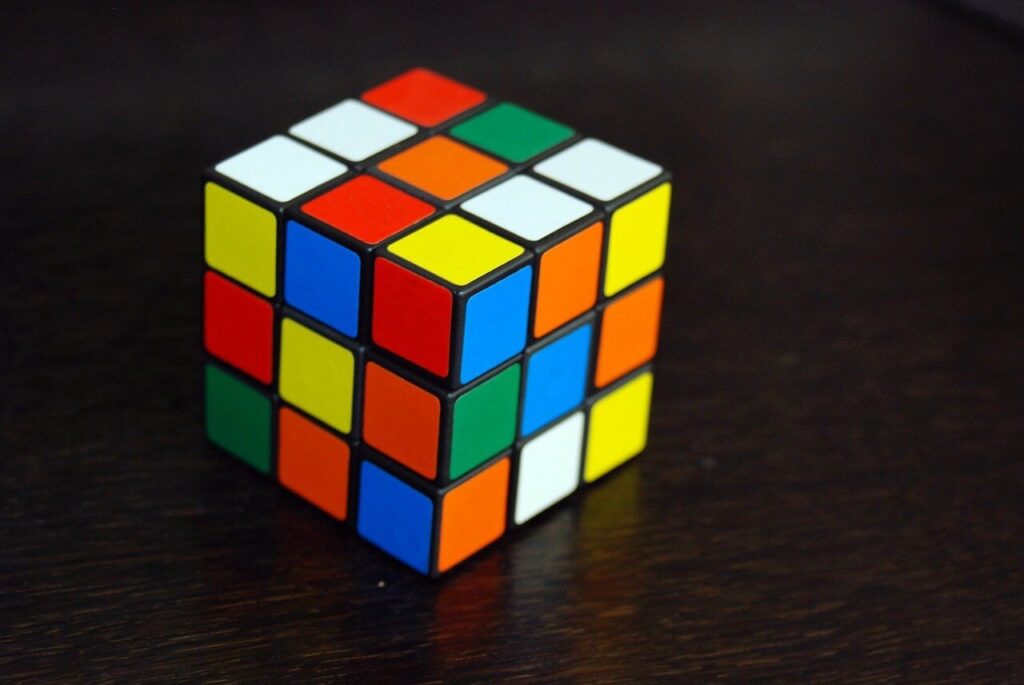
The invention didn’t become a worldwide hit straight away. In 1975 the mechanism was patented, and at that time the puzzle was called the Magic Cube. Sales in Hungary began at the end of 1977. In 1979 the cube was shown at toy fairs in Europe and in New York, and in 1980 it was renamed the Rubik’s Cube and went on sale worldwide.
These dates help you tell apart three stages: the birth of the idea, the arrival of the product and its global popularity. It wasn’t a single event, and it wasn’t just the result of friends recommending a new toy to each other.
How many positions does the cube have, and how many moves are enough?
The classic 3x3x3 cube has 43,252,003,274,489,856,000 possible positions, or more than 43 quintillion. That’s why turning it at random will practically never lead you to the solution.
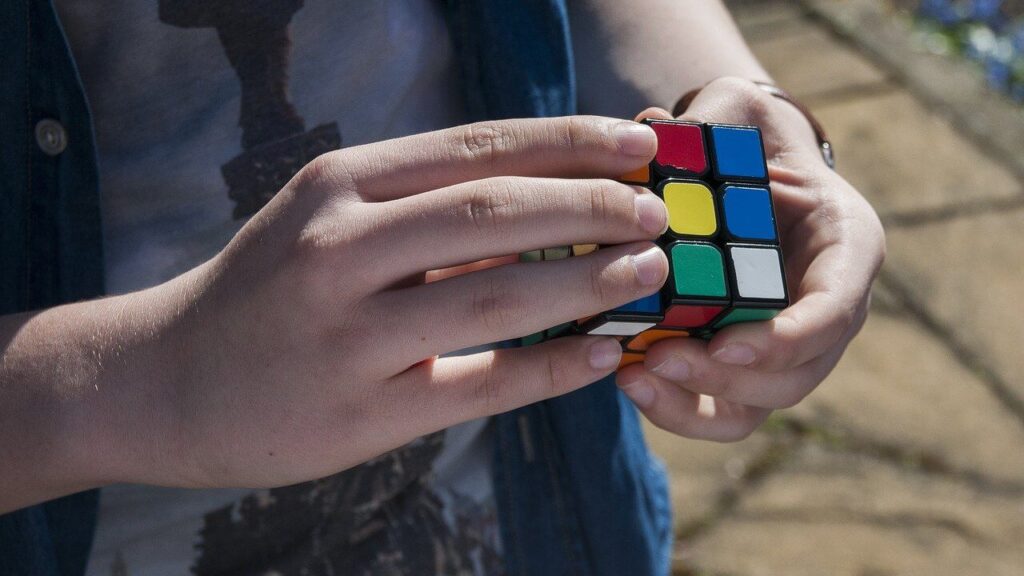
For years, mathematicians looked for the answer to the question of how many moves are enough to solve the cube from any scrambled position. This number became known as God’s Number. In July 2010 a team made up of Tomas Rokicki, Herbert Kociemba, Morley Davidson and John Dethridge showed that it’s 20. The calculations used computing power equivalent to about 35 years of work by a single processor. The result applies to a way of counting in which every turn of a face, including a 180-degree turn, counts as one move.
The number 20 doesn’t mean that a person solves the cube in 20 moves. It’s the theoretical minimum for the worst case. The methods people learn don’t look for the shortest path, but for one you can remember and actually carry out.
Why are the next moves so addictive?
The cube quickly shows you that success in one place can come at a cost somewhere else. You get a matching colour lined up on one face, but in the process you move pieces on the next one. To act more predictably, you have to notice what whole sequences of moves do.
You can try it intuitively, write down your own observations or learn a method from a guide. They’re all different ways to play. Using a guide doesn’t take the point out of solving, just as working things out on your own doesn’t have to end in a quick result.
How to start if you want to solve your first cube
The manufacturer’s official beginner’s guide breaks solving down into stages done layer by layer. In short, it looks like this:
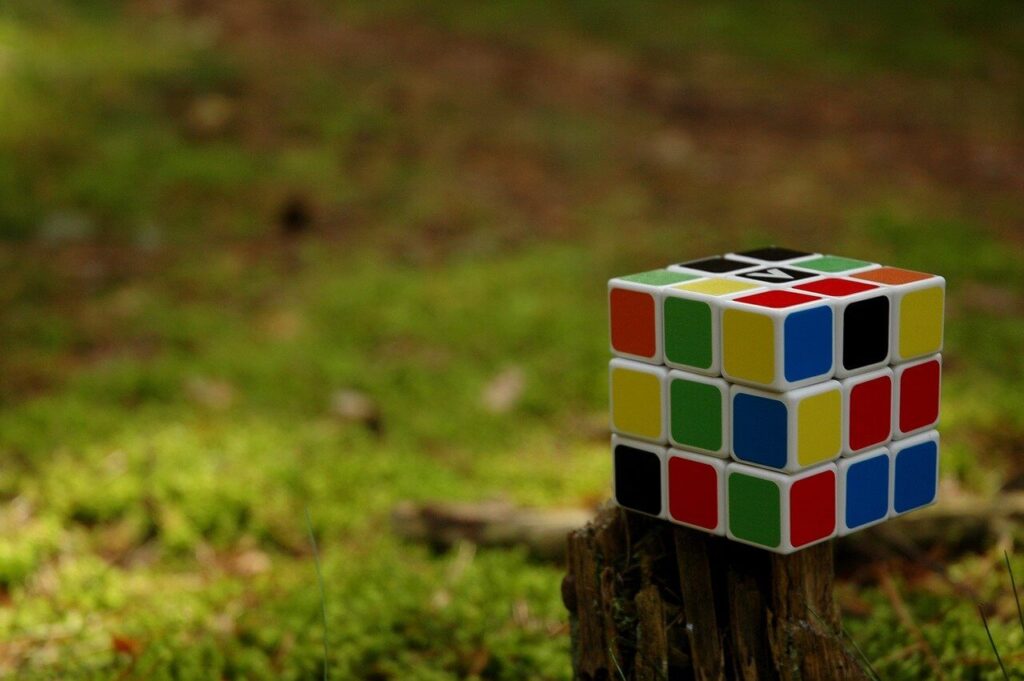
- The white cross: first you place the edges around the white centre so that they also match the centres of the side faces. The guide starts with a helper pattern called the daisy.
- The white corners: you complete the first layer.
- The middle layer: you insert the edges of the second layer.
- The yellow cross, corners and edges: you finish the last layer with short, repeatable sequences.
To begin with, choose one goal: understand a particular stage, perform a sequence correctly or solve the whole cube for the first time. Mixing learning with the pressure of a stopwatch can take the fun out of discovering things for no good reason. If you get lost along the way, go back to the last stage you can repeat, rather than scrambling the cube all over again.
From fan meet-ups to championships
A community grew up around the cube, sharing methods and results. In 1982 Budapest hosted the first world championship, and the winning time was 22.95 seconds. The history of competitions wasn’t a steady march towards ever bigger events, though. After 1983 the craze for the cube faded, and for years no major competitions were held. The internet played an important part in bringing fans back together, with websites sharing guides and results appearing from the mid-1990s.
The next world championship was held in 2003 in Toronto, with 89 competitors. In 2004 the World Cube Association was founded, the organisation in charge of official competitions and the rules for comparing results. According to its figures, more than 140,000 people from 143 countries have already taken part in official competitions. On the organisation’s website you can check the competition calendar, including events in Poland, and the current records.
Speed solving takes more than making good moves by chance. What counts is recognising the pattern, knowing a method and working smoothly. Not every decorative or unusual version of the cube is a separate official event, though.
The cube as a puzzle for one
You usually solve the cube on your own. There’s no storyline and no clues hidden around you. There’s just a pattern of colours and moves you can repeat until you get there. That’s why it works so well as a calm pastime at your desk or on a journey, and your progress is easy to measure: first the first layer, then the whole cube, and over time a faster time.
It doesn’t need a promise of making you smarter to be satisfying, either. All it takes is the moment when a jumble of colours falls back into order.
Author of this post

Redakcja KrakowSecrets
Zespół redakcyjny KrakowSecrets. Piszemy o krakowskich miejscach, trasach i wydarzeniach, a praktyczne szczegóły – godziny, ceny, dojazd – sprawdzamy przed publikacją.
More from this category
Latest posts
Recently added
Editor’s note
One good tip every Wednesday
No daily noise or random list of events.
gramiejskakrakow.pl
Turn a walk into a city mission
If you’re going as a group, choose the version with puzzles and a shared finale.
More from the blog