
Escape rooms for children at Gamescape in Krakow
Escape rooms for children at Gamescape in Krakow: the age rules for minors, which rooms suit children best, what to tell the staff when you book and when a city game is the better choice.
Redakcja KrakowSecrets
/
Publikacja: September 13, 2023
/
Aktualizacja: October 1, 2026
In this guide
A child can play an escape room at Gamescape in Krakow, but up to the age of 14 only if an adult guardian plays alongside them in the same team. Most rooms are marked “child-friendly” on their cards. Dead Man’s Chest comes with the fewest caveats: it’s a pirate adventure with no warning about tight passages or low light. Anatomy of Crime 2 is for players aged 16 and over.
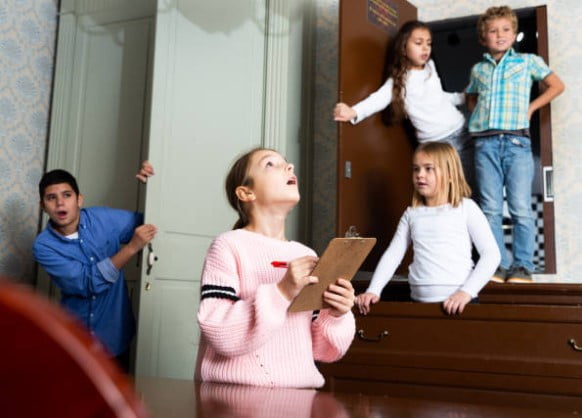
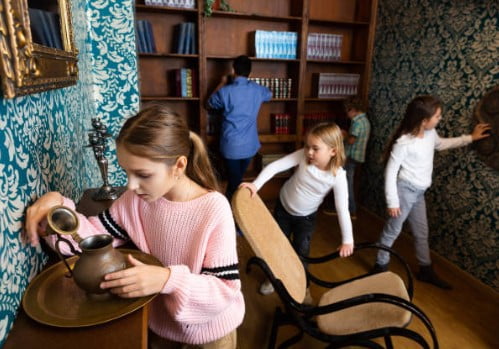
A school of magic or a hunt for pirate treasure can be a nice idea for a family outing. Before you book, though, it’s worth checking more than the photos of the set. For a child, low light, tight passages, the length of the game, the way tasks are delivered and having a familiar adult nearby all matter too.
From what age, and with whom, can a child play?
The rules for minors are set out in Gamescape’s game rules (in Polish). According to the version checked in September 2026:
- A child under 14 can only play if their adult guardian also takes part in the game and looks after them.
- A teenager aged 14 to 18 can play with a guardian in the team. In an escape room they can also play without a guardian in the team, as long as an adult guardian waits on Gamescape’s premises for the whole game, or the teenager brings a consent form signed by their parents or legal guardians.
- An organised group, such as a school class or a team of friends at a birthday party, agrees the number of guardians needed with the staff on a case-by-case basis.
You need to tell a member of staff that children are taking part before the game starts. Any age limits for a particular scenario are listed on its card. In practice, this means that a ten-year-old won’t be able to go in with their friends without an adult, while a fifteen-year-old can play with friends if a parent stays on site or signs a consent form.
Which room should you choose for a child?
The details below come from the room cards, checked in September 2026:
- Dead Man’s Chest: a pirate story in which treasure hidden by corsairs is waiting for the next daredevils. For 2 to 6 people, 65 minutes. The card stresses that the room is child-friendly and has no live spiders. There’s no warning about tight passages or low light, and the room is also described as accessible for people with disabilities.
- Enchanted Amulets: a tale of feuding Schools of Magic and a search for the artefacts needed to find the Cup of Life. For 2 to 8 players, 65 minutes, marked “child-friendly”. The card clearly warns that the room is dimly lit. For a child who’s afraid of the dark, that matters more than the description of the magical adventure.
- Dragon’s Curse, Chimera Protocol and House of Krak are also marked “child-friendly”, but each of them has tight spaces and narrow passages. House of Krak lasts 90 minutes, which is a long game for a younger child.
- Anatomy of Crime 2 is a dark crime case for players aged 16 and over. It isn’t the next step up after the pirate adventure, but a scenario for older teenagers and adults.
A “child-friendly” label doesn’t mean every young player will feel equally at ease in the room. One child loves mysteries and happily searches every corner, another needs a well-lit space and time to get used to somewhere new. And don’t assume that because the puzzles can be simplified in one room, the same applies to the others.
No live spiders doesn’t automatically mean no decorations that look like them. If your child is also scared of fake spiders, ask about them directly. A specific question will help you pick the right adventure better than just asking whether the room is scary. In the same way, tell the staff about anything else that might bother your child: darkness, sudden noises, tight passages or an actor in the room. A magical or pirate theme on its own doesn’t guarantee that none of these will be there.
What should you tell the staff when you book?
Say how old the youngest player is, whether the children can read on their own, and whether they’ve played anything similar before. Under the rules, a guardian playing in the team counts as a player, so include them in the team size when you plan and confirm this when you book. This matters especially for birthday parties and outings with several sets of siblings.
For a birthday, check whether you’re booking a game in a single room or a birthday package. Gamescape’s packages are described as designed for children aged 8 to 14, and a parent or group guardian must play in every room. According to the packages page, a dedicated Game Master can take the guardian’s place in the room, for an extra fee and subject to availability. Check the scope of the package, the timings and the terms on the website before you book, because they differ from the rules for a regular game.
It helps to explain to your child what’s coming: they’ll look for clues, examine objects and talk with the team. They don’t have to solve every task on their own. They can also tell an adult that they need help or want to leave. At Gamescape the room door stays open, and the Game Master watches the team on camera and can talk to them, so leaving doesn’t depend on solving a puzzle.
The adult helps, but doesn’t take over
A guardian can read out a longer clue and make sure everyone has heard it. After that, give the children time to come up with their own idea. If an adult keys in every code straight away, the rest of the team quickly turns into spectators. A simple agreement helps: first ask the child what they’ve noticed, and only then add your own observation.

A practical split might look like this: one person reads the message, another looks for matching symbols, and a third checks whether the group has used every item. You can swap roles as you go. This is just a suggestion for how to organise yourselves, not a set of tasks from any particular room.
Leave plenty of time for the visit
The time on the card covers the game itself. On top of that, you’ll need to arrive before the start, listen to the host’s introduction and take a moment after the finale. Don’t book the next activity for the second the countdown ends, and leave time before the game for a relaxed meal and the journey. A tired child copes worse with the pressure of the clock than one who arrives well rested.
After the game, instead of asking whether you won, ask which clue was the most interesting or when someone helped the others. At home, the children can draw their own treasure map or invent a puzzle for the grown-ups.
When your child would rather have an adventure outdoors
If your child doesn’t like enclosed spaces or low light, a city game is a good alternative. Magic Portal is designed for children aged 7 to 12 and lasts 120 minutes, while Treasure Hunters is a 90-minute family game on a route along the Rudawa river. In both, the team uses a tablet. In a city game the rules don’t allow for a guardian waiting on the premises: a minor plays with an adult guardian in the team.
For a birthday or a family walk, it’s best to choose a game your child actually wants to play. If they don’t want to go in, changing the plan makes more sense than insisting that everyone is supposed to be having fun. Don’t tell them that pulling out will ruin the birthday. If a fear of enclosed spaces lasts, an escape room isn’t the way to overcome it.
Author of this post

Redakcja KrakowSecrets
Zespół redakcyjny KrakowSecrets. Piszemy o krakowskich miejscach, trasach i wydarzeniach, a praktyczne szczegóły – godziny, ceny, dojazd – sprawdzamy przed publikacją.
More from this category
Latest posts
Recently added
Editor’s note
One good tip every Wednesday
No daily noise or random list of events.
gramiejskakrakow.pl
Turn a walk into a city mission
If you’re going as a group, choose the version with puzzles and a shared finale.
More from the blog