
The Wawel Dragon: the legend, the statue and the Dragon’s Den
The Krakow dragon explained: how the Wawel Dragon legend changed over the centuries, the fire-breathing statue by Bronisław Chromy, and how the one-way Dragon’s Den route works.
Redakcja KrakowSecrets
/
Publikacja: October 29, 2023
/
Aktualizacja: October 1, 2026
In this guide
In its most popular version, the legend of the Wawel Dragon goes like this: a dragon lives beneath Wawel Hill and devours the townspeople’s cattle, until a clever cobbler called Skuba defeats it. He feeds the beast a ram stuffed with sulphur, and the dragon drinks water from the Vistula until it bursts. Below Wawel you’ll easily meet people who’ve known this story since childhood and are waiting by the statue for fire to burst from the dragon’s mouth. Before you set off, it helps to separate three things: the legendary beast, the modern statue and the cave the story has been tied to.
How was the dragon defeated?
In the popular version of the tale, the dragon terrorises King Krak’s settlement and demands animal sacrifices. The knights are no match for it. It’s only defeated by Skuba the cobbler, who slips the beast an animal stuffed with sulphur. Once it has swallowed the bait, the dragon’s throat burns, so it drinks water from the Vistula until it bursts. Victory comes from a good idea, not from strength.
On a walk with a child, you can ask why cleverness wins in this story. That kind of chat doesn’t need a long lecture. Sometimes it’s enough to come up with your own, completely peaceful way of persuading the dragon to leave its cave.
Where did the cobbler version come from?
The cobbler wasn’t part of the story from the start. The legend changed over several centuries, and each chronicler told it a little differently:
- Wincenty Kadłubek (around the turn of the 12th and 13th centuries) wrote down the oldest known version. He describes an all-devouring monster living in a cave below the hill, defeated by Krak’s sons, who feed it cattle hides stuffed with burning sulphur. This version ends grimly: one brother kills the other.
- Jan Długosz (15th century) changed the story so that King Krak deals with the dragon himself.
- The Bielski chronicle (16th century) introduced the crafty cobbler Skuba and the dragon’s death from drinking too much. This is the version that has survived to this day in children’s books.
So the cobbler story isn’t an account of a historical event. What makes the legend interesting is precisely that you can compare its versions. For older children, a good question for the walk is: why is the hero in the newer version an ordinary craftsman and not a king’s son?
The dragon statue on Bulwar Czerwieński
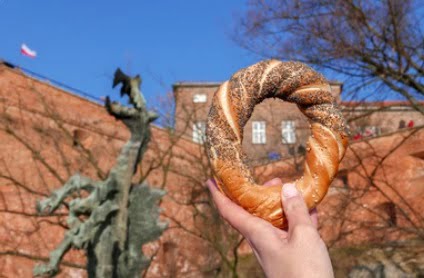
The Wawel Dragon statue was created by Bronisław Chromy. It was put up in 1972 right next to the exit from the Dragon’s Den, on a limestone rock above the Vistula. It’s a six-metre dragon cast in bronze. It stands on two legs, propped up on its tail, and seven long necks with heads grow out of its body. The statue refers to the legend, but it isn’t a memento of a real encounter with a monster.
Sometimes the dragon breathes fire. The effect comes from a built-in gas installation. Don’t count on a particular time, because how the installation works can change. Sometimes you’ll have to wait a moment, and sometimes there won’t be any fire at all. You can see the statue for free, from the level of the embankment, with no steps, so it’s a good spot for people with pushchairs or wheelchairs too.
A photo with the dragon goes well with a walk along the Vistula. When it’s crowded, give other people some space, and don’t plan your whole day around a single fire-breathing moment.
The Dragon’s Den: in on the hill, out by the dragon
The Dragon’s Den is a natural cave in the western slope of Wawel Hill. In total it has about 270 metres of passages, of which visitors walk an 81-metre route through three chambers. The most important practical point: the route only goes one way.
- The entrance is on Wawel Hill, near the Thieves’ Tower. You go down inside a brick tower, a former well from the Austrian period.
- The way down is a steep spiral staircase with 135 steps.
- The exit leads out onto the Vistula embankment, right below the dragon statue.
- Accessibility: the cave is not accessible to wheelchair users, and you can’t go down with a pushchair.
- Season and tickets: the cave is open seasonally and closed out of season, and entry requires a ticket. Check current opening hours, prices and entry rules on the official Wawel Royal Castle website.
At the exit from the cave, look out for a commemorative plaque from 1871 on the defensive wall. It refers to Prince Krakus, who according to legend founded Krakow and slew the dragon.
How to combine the cave and the statue in one walk
Since the cave only goes one way, it’s worth deciding the order before you set off:
- You want to see both: start on Wawel Hill, go down through the Dragon’s Den and finish at the statue on the embankment. You won’t have to climb back up afterwards.
- You’re with a pushchair or a small child, or steep stairs are hard for you: walk along the embankment straight to the statue and skip the cave. You can tell the legend by the dragon.
- The cave is out of season: you can still see the statue, because it stands on the open embankment.
The dragon’s story can lead you further
If legends are what interest you most, the Krakow Legends app lets you explore the city through tasks. It’s a self-guided game on your phone, and you can take breaks. Check the route description and requirements before you start.
You can end your outing with a photo by the statue, or turn it into a whole day of Krakow stories. The dragon is a good start for either plan.
Author of this post

Redakcja KrakowSecrets
Zespół redakcyjny KrakowSecrets. Piszemy o krakowskich miejscach, trasach i wydarzeniach, a praktyczne szczegóły – godziny, ceny, dojazd – sprawdzamy przed publikacją.
More from this category
Latest posts
Recently added
Editor’s note
One good tip every Wednesday
No daily noise or random list of events.
gramiejskakrakow.pl
Turn a walk into a city mission
If you’re going as a group, choose the version with puzzles and a shared finale.
More from the blog