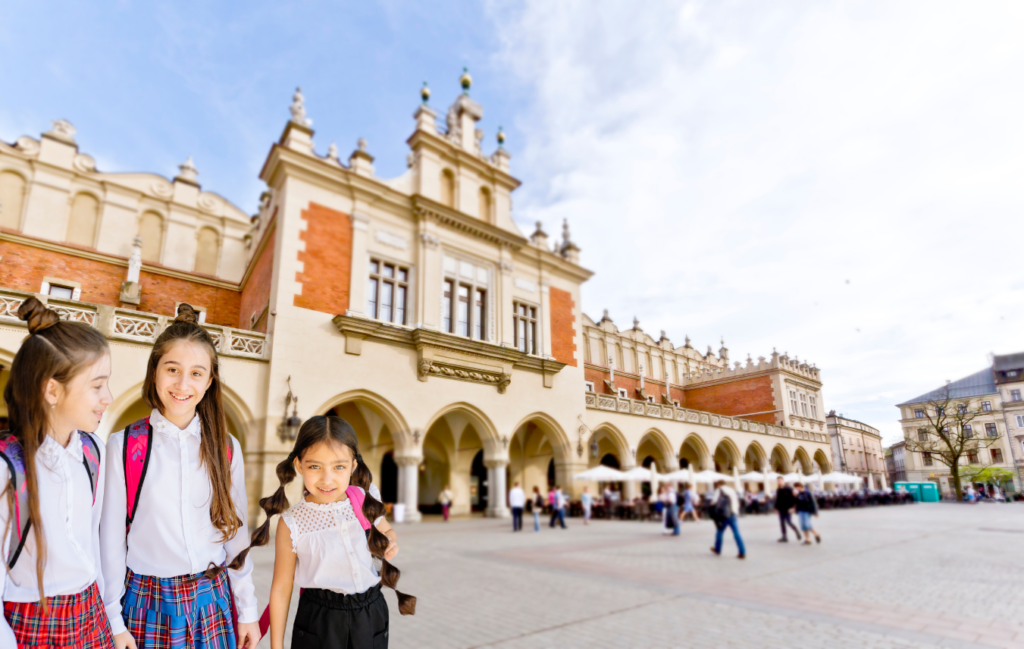
An interesting school trip to Krakow: the city as a challenge
Three sample plans for a school trip to Krakow by year group: a museum lesson, an outdoor city game and a meal break, plus team roles and questions to ask before you book.
Redakcja KrakowSecrets
/
Publikacja: December 30, 2024
/
Aktualizacja: October 1, 2026
In this guide
An interesting school trip to Krakow doesn’t need a long list of sights. Three blocks are enough: a museum lesson matched to the students’ stage of education (usually about an hour), an outdoor city game (from an hour and a half to two and a half hours), and a relaxed meal break in between. First the students learn something about the city, then they go out and look for traces of that history themselves. Below you’ll find three sample day plans for different year groups, a way to share out roles in teams, and a list of questions to ask before you book.
Before you choose attractions, decide what the day is for. Does the class need an adventure together? Or should the trip back up a history lesson, or show students how to read a city map? Each of these goals leads to a slightly different programme.
Grades 1 to 3: legends underground and a game for children
Morning: Rynek Underground. At this branch, the Museum of Krakow runs the lesson “Pogromcy legend, czyli różnica między bujdą a historią” (“Legend busters: the difference between a tall tale and history”) for preschools and grades 1 to 3. Children hear three Krakow legends: about Prince Krak, about the bugle call from the tower of St Mary’s Church and about the two brothers, and then they check which parts are history. You’ll find topics, dates and booking rules in the Museum of Krakow’s lesson finder, and visiting conditions on the branch’s page. The museum only accepts school bookings from the school’s official email address.

After lunch: a city game for children. Magic Portal is a fantasy game for children aged 7 to 12: teams of 1 to 6, 120 minutes, difficulty 4/10, and a route of up to 3.5 km towards Wawel. The start and finish are at ul. Kościuszki 74, away from the Main Square, so allow time to walk or travel there.
A calmer option. The Krakow Legends app has no time limit and no fixed start time. You can take breaks, and each team plays on one phone. With younger children that’s handy, because the teacher sets the pace, not the clock.
For this age group, plan shorter stretches on foot and a break every hour. The lesson about legends goes well with a simple exercise along the route: in two columns, children write down what was in the legend and what they heard from the museum educator as fact. A fantastic story can spark interest in a place, but it isn’t evidence of something that really happened.
Grades 4 to 8: the history of the market square and a game along the Royal Route
Morning: a museum lesson. You can choose, for example, the lesson “Jak powstał krakowski rynek” (“How Krakow’s market square came to be”) at Rynek Underground (grades 4 to 8), or lessons for schools at Wawel, where the programme for grades 4 to 8 lasts 60 minutes. Check the details on the Castle’s page for schools and teachers (in Polish).
Afternoon: Kraków Legends with Game Masters. In the version run by EscapeCity, the Game Masters wait on plac Matejki (full version, up to 2.5 hours) or on plac Mariacki (shorter version, up to 2 hours). They split participants into teams, hand out iPads and explain the rules. The route is about 3 km long, follows the Royal Route through the Old Town and finishes on the Vistula Embankments, where all the teams meet for the results.
This set-up has a practical advantage: after the lesson at Rynek Underground, the start of the game is close by, and the finish by the Vistula is a natural place to gather the whole class. If your students are learning English, ask about playing in English. The operator offers it, but for this game it costs extra.
Grades 7 to 8 and secondary schools: harder history and a longer game
Morning: Oskar Schindler’s Enamel Factory. Here the Museum of Krakow runs workshops about the occupation of Krakow, for example “Codzienność okupowanego Krakowa i jego mieszkańców” (“Everyday life in occupied Krakow and its residents”) or “Szare księgi” (“The Grey Books”), about the choices residents made during the war, as well as walks around plac Bohaterów Getta and Rynek Podgórski. Most of these sessions are for grades 7 and 8 and secondary schools. You’ll find the current list and conditions on the branch’s page. The museum sells tickets online up to 90 days before your visit. For named tickets bought online, you need to bring an ID document.
A break to talk. After a lesson about the war, don’t go straight into competition. A quarter of an hour or so for a meal and a relaxed chat helps students move on to another part of the day.
Afternoon: a game for older students. EscapeCity’s city games include harder scenarios, for example Blackout, on a route of about 3.2 km from Mały Rynek through Kazimierz. With a longer route and higher difficulty, older students have more to solve on their own.
A science option from April to October. The Stanisław Lem Experimental Garden at al. Pokoju 68 has interactive, hands-on stations covering mechanics, optics and acoustics. It’s seasonal and closed outside the season.
Splitting the class without leaving anyone out
When students work in teams, it’s easy for one person to end up reading all the clues and making all the decisions. A simple division of roles helps prevent this. One person reads the task, another keeps track of the direction, a third collects ideas, and the next one checks the answer. After each stage, the roles rotate. Don’t assign fixed roles based on school marks, because a quiet student should also get the chance to share their idea.
This is an organisational suggestion that needs adapting to the game. In games with Game Masters, they split participants into teams themselves unless you ask for a different split. It’s worth agreeing this in advance and explaining to students that asking for a hint isn’t a failure.
What to agree before you book
- Class details. Game operators ask for the number of students, their age, the date and the start time. They use this to choose the scenario and difficulty level.
- Supervisors. Both EscapeCity and Gamescape let teachers and supervisors join for free. Running the game doesn’t mean taking over the school supervisors’ duties, though, so decide who goes with which team.
- Payment. EscapeCity asks for a deposit for 10 or 20 tickets, depending on the size of the group, and on the day of the trip you pay the balance for the actual number of participants. Public schools can get an invoice with a deferred payment date.
- Language. If you’re playing in English, confirm the language of the tasks and hints. Match your choice to the class’s level, so the game doesn’t turn into an exam where only two people understand the instructions.
- Weather. EscapeCity plays in light rain and hands out rain ponchos, and in strong wind, a downpour or a storm it arranges an alternative date. Your bad-weather plan could be the escape room for schools at Gamescape: groups of 15 to 52, children from 8 years old, a game of one to one and a half hours, with the option to make the puzzles easier for younger students.
- Waiting time. With several teams, ask about parallel starts and where teams that finish early can wait.
- Students’ needs. Ask whether the route and rooms are accessible for students with limited mobility or those who need more time to read.
Back at school
Ask students to pick one discovery from the trip and explain how they got there. You could compare the notes on legends and facts, reconstruct how a puzzle was solved, or point to a question that’s still open.
The most interesting trip doesn’t always have the most attractions. Sometimes one task done well stays with students longer than a day spent mostly rushing through Krakow.
Author of this post

Redakcja KrakowSecrets
Zespół redakcyjny KrakowSecrets. Piszemy o krakowskich miejscach, trasach i wydarzeniach, a praktyczne szczegóły – godziny, ceny, dojazd – sprawdzamy przed publikacją.
More from this category
Latest posts
Recently added
Editor’s note
One good tip every Wednesday
No daily noise or random list of events.
gramiejskakrakow.pl
Turn a walk into a city mission
If you’re going as a group, choose the version with puzzles and a shared finale.
More from the blog