Interesting facts about Krakow that change an ordinary walk
Interesting facts and legends about Krakow, from the broken-off Hejnał and St Mary’s uneven towers to the Sigismund Bell and the Krzysztofory ghost, plus small tasks for your walk.
Redakcja KrakowSecrets
/
Publikacja: November 30, 2024
/
Aktualizacja: October 1, 2026
In this guide
On Krakow’s Main Market Square it’s easy to get stuck on one view. The towers of St Mary’s Basilica, the Cloth Hall and all the bustle around them compete for your attention at once. Every now and then, pick one detail and find out how it connects to the city’s history. Suddenly even a route you know well starts telling you something new.
The facts below lead from the Old Town via Wawel to Kazimierz. You don’t have to tick off every place in one day. They can be the start of several shorter outings.
In a nutshell, before you set off:
- In 1978 it wasn’t just the Market Square that made the UNESCO World Heritage List, but also Wawel and Kazimierz with Stradom.
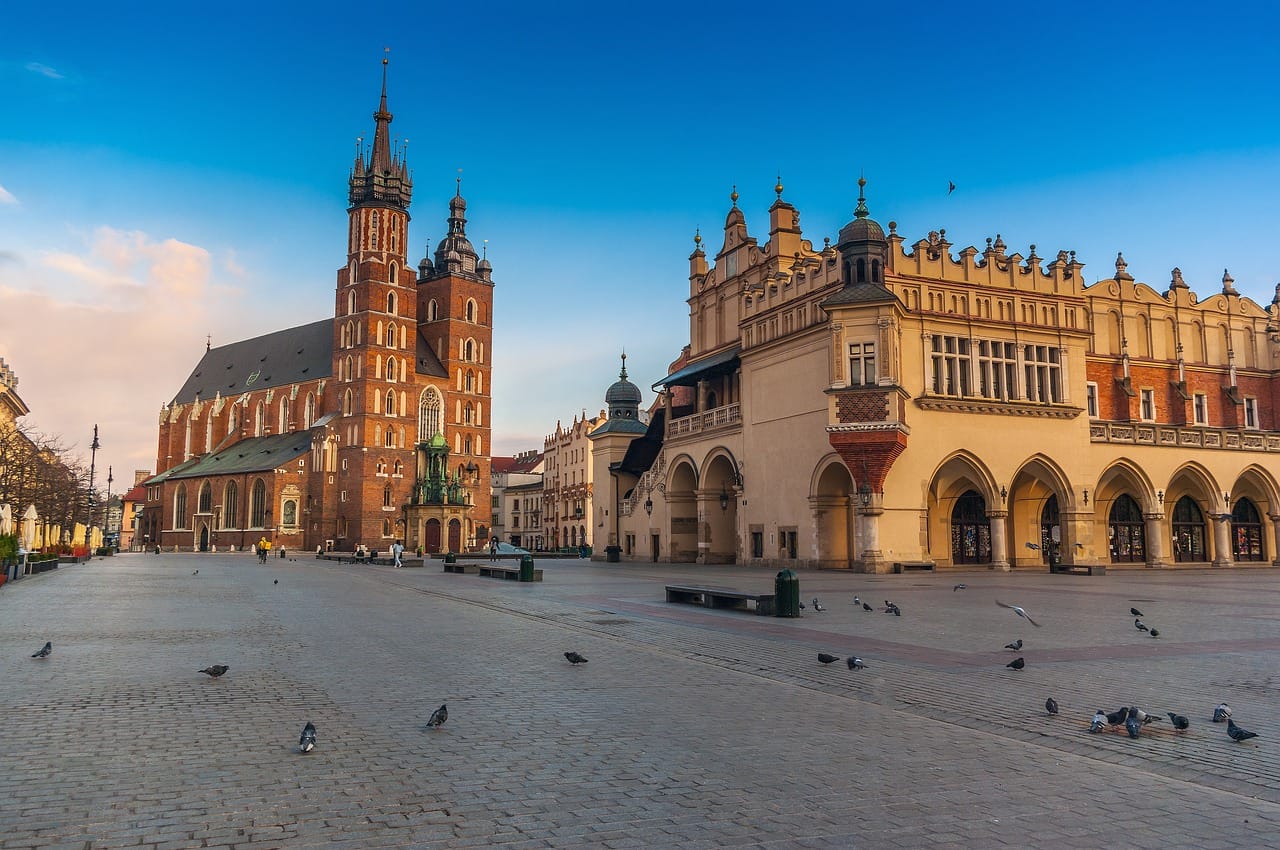
- The towers of St Mary’s Basilica are different heights: the north one, known as the Bugle Tower, is 82 m tall, and the south one, the bell tower, is 69 m.
- The Hejnał, St Mary’s bugle call, is played every hour and breaks off halfway through. Legend links this to a watchman hit by a Tatar arrow.
- According to legend, the knife hanging in the Cloth Hall is a reminder of a fratricide during the building of St Mary’s towers.
- The Planty, the park that rings the Old Town, was laid out where the old defensive walls, moat and ramparts used to be.
- The Sigismund Bell at Wawel was cast in 1520, and it takes 12 bell ringers to set it swinging.
- The Jagiellonian University was founded by Casimir the Great in 1364. It’s the oldest university in Poland.
- Nicolaus Copernicus began his studies in Krakow, as recorded in the university register in 1491.
- Krzysztofory Palace at Rynek Główny 35, home of the Museum of Krakow, has its own ghost and its own legend, according to the museum itself.
- Wawrzynek and the yellow shoe is a tale about a boy helping with the work on Veit Stoss’s altarpiece, not a documented biography.
Krakow on the UNESCO list is more than the Market Square
The historic centre of Krakow was added to the UNESCO World Heritage List in 1978. The listed area covers the medieval town, Wawel, and Kazimierz with Stradom. That’s an important difference if you’re planning to sightsee only around the Market Square.
Putting these parts side by side shows you the different roles old Krakow played. The Market Square leads you into the history of trade, Wawel Hill into the seat of power, and Kazimierz also into the history of the Jewish community and of what was once a separate town.
On your walk, pick one place from each part. You don’t have to go inside everywhere. Simply comparing the layout of the squares and streets helps you notice that the centre didn’t appear as one ready-made whole.
The Cloth Hall sits in the middle of city life
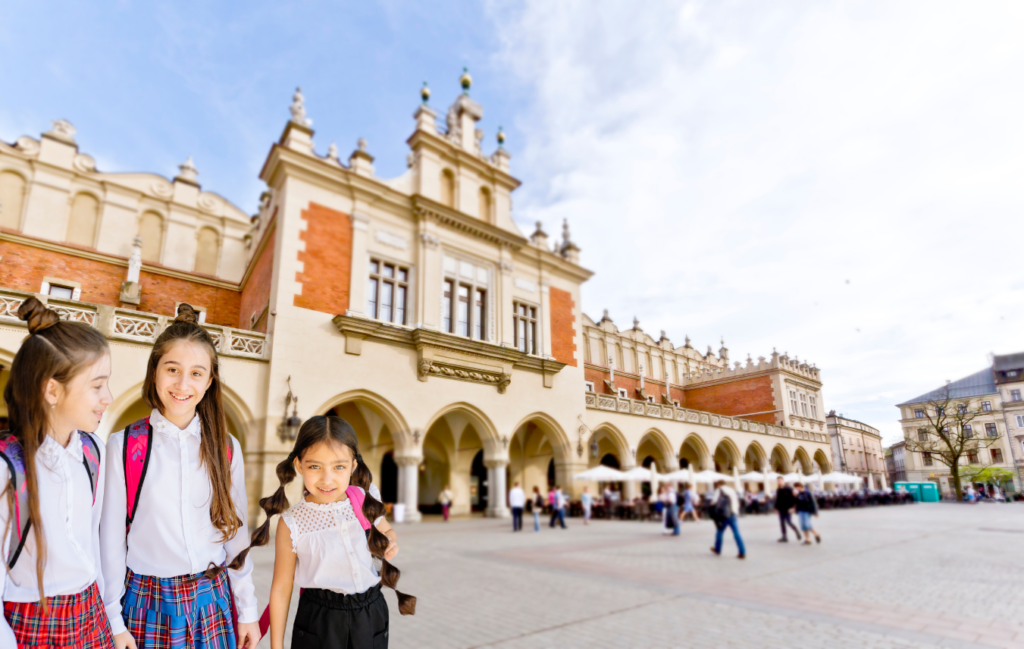
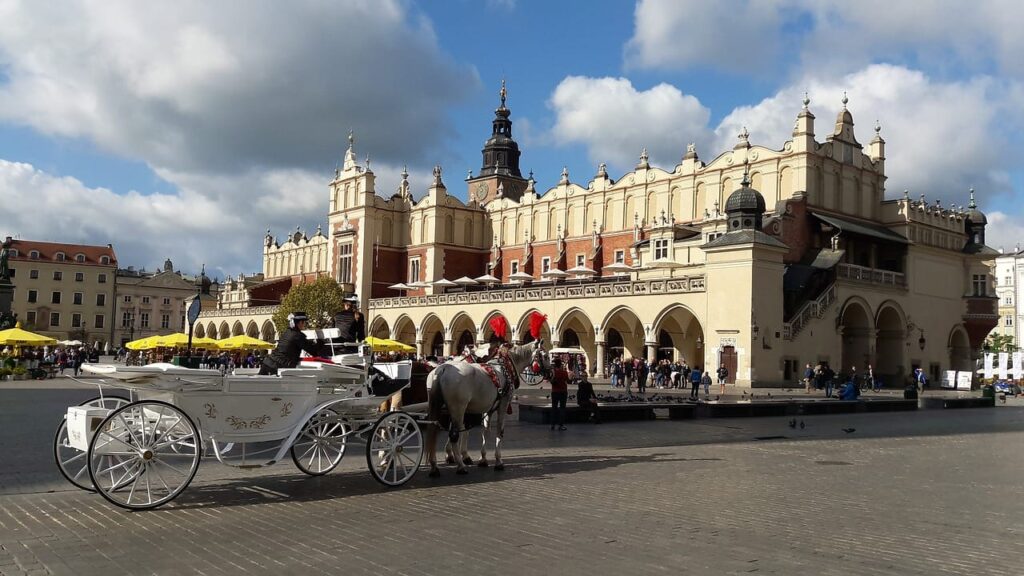
The Cloth Hall takes up the central part of the Market Square. Its trading history is a good starting point for thinking about how a city of merchants worked. Instead of treating the building as just a photo backdrop, walk around it and look at the passages and at how people use them today.
You can give children their own observation task. Ask them to show you the easiest way a merchant could have got there with his goods, and where he’d have met the most passers-by. It’s a game of imagining the old city, not a reconstruction of any particular historical market.
Two uneven towers and a broken-off bugle call
St Mary’s Basilica has two towers of different heights. According to the basilica’s website, the taller, north one, the Bugle Tower, is 82 m high, and the lower, south one, which serves as the bell tower, is 69 m. At the top of the Bugle Tower sits a golden crown, in its current form from 1666, restored in 2023.
Every hour the Hejnał, St Mary’s bugle call, rings out from the Bugle Tower, played from a height of 54 m. The tune always breaks off at the same point. Legend has it that in the 13th century a watchman spotted the approaching Tatars and began sounding the alarm, but halfway through the tune he was struck by an arrow. On the Market Square, all you need to do is stop on the hour to hear that broken-off ending.
A different story explains why the towers are different heights. Two brothers were each building a tower, and when the elder brother’s tower started to outgrow the younger one’s, the younger brother killed the elder in a fit of jealousy. Later he confessed and threw himself from the tower. According to legend, the knife hanging in the Cloth Hall is a reminder of this story. It’s a good example of a legend adding drama to a real architectural detail. The knife itself isn’t proof that it ever happened.
You can visit the Bugle Tower. The basilica’s website says visitors go up in groups of up to 15, and children under 7 aren’t allowed in for safety reasons. Check current opening hours on the St Mary’s Basilica website.
A park where the walls stood and a bell for great occasions
When you walk along the Planty, you’re circling the Old Town along the line of its old fortifications. According to the city’s website (in Polish), the park was created where the defensive walls, moat and earth ramparts used to be. It’s made up of eight gardens named after the places next to them, including Barbakan, Florianka, Uniwersytet and Wawel. You can learn about the history of the medieval fortifications at two branches of the Museum of Krakow: the Barbican and the City Defence Walls on ul. Pijarska.
At Wawel, look up when you pass the Sigismund Tower. According to the Wawel Cathedral website, the Sigismund Bell was cast in Krakow in 1520 by the Nuremberg bell founder Hans Behem, and the people of Krakow first heard it on 13 July 1521. The bronze bell alone weighs 9,650 kg, and it takes 12 bell ringers to set it swinging. It doesn’t ring every day, only on the most important church and national holidays, such as 3 May and 11 November.
A palace with its own ghost
At Rynek Główny 35 stands Krzysztofory Palace, home of the Museum of Krakow. In its programme for children, the museum itself points out that the palace has its own ghost and that a legend is linked to the residence. One of the workshops is called “Chasing the Krzysztofory Rooster”.
It’s a good hint on how to treat the city’s ghost stories. The institution doesn’t pretend it’s a fact, but it doesn’t erase the story from the building’s memory either. If you visit Krzysztofory with children, ask them what might haunt this palace, and then compare it with what you can actually see in the exhibition.
Nicolaus Copernicus and the university
Krakow’s university was founded by King Casimir the Great on 12 May 1364. After the king’s death it stopped operating, and in 1400 it was re-established by Władysław Jagiełło. According to the Jagiellonian University, it’s the oldest university in Poland. Nicolaus Copernicus is part of Krakow’s story too. An entry in the university register from 1491 records the start of his studies. So a walk around Collegium Maius can turn into a conversation about the city as a place of learning, where people from many different places met.
It’s worth separating a specific document from later ideas of what a student’s daily life was like. The entry itself doesn’t say which window he sat by or what each day of his stay looked like. History can be fascinating without adding scenes like that as facts.
Churches let you read the city in layers
St Mary’s Basilica, St Andrew’s Church and the Church of Saints Peter and Paul differ in their shape and detail. In Kazimierz, Corpus Christi Basilica can be your next point of comparison.
On a short walk, try to spot one difference that you can describe in your own words. Does the building feel massive or light? What catches your eye on the façade? You don’t need to know the whole vocabulary of art history straight away. One concrete observation helps you make sense of a monument’s description later on.
Legends feed the imagination, but they don’t replace history
The Wawel Dragon and the tale of Wawrzynek belong to Krakow’s world of legends. You can enjoy them alongside the documented history, as long as you remember the difference between the two. In the same way, a simple break for an obwarzanek gets more interesting when you look at its braided shape and ask about the local baking tradition.
In the tale of the yellow shoe, Wawrzynek helps Veit Stoss with his work on the altarpiece in St Mary’s Basilica. The boy loses a leather shoe there, and it turns up again in the story many years later. This small object lets you picture the church as a place full of work and people, as long as you treat the scene as a legend.
If you’d rather get to know the city through puzzles, Krakow Legends on your own phone takes you around the centre in an app, with no time limit and the option to take breaks. Whichever way you explore, it’s worth going back afterwards to one place you noticed. A detail you gave a moment of your attention often stays with you longer than a long list of monuments.
Author of this post

Redakcja KrakowSecrets
Zespół redakcyjny KrakowSecrets. Piszemy o krakowskich miejscach, trasach i wydarzeniach, a praktyczne szczegóły – godziny, ceny, dojazd – sprawdzamy przed publikacją.
More from this category
Latest posts
Recently added
Editor’s note
One good tip every Wednesday
No daily noise or random list of events.
gramiejskakrakow.pl
Turn a walk into a city mission
If you’re going as a group, choose the version with puzzles and a shared finale.
More from the blog