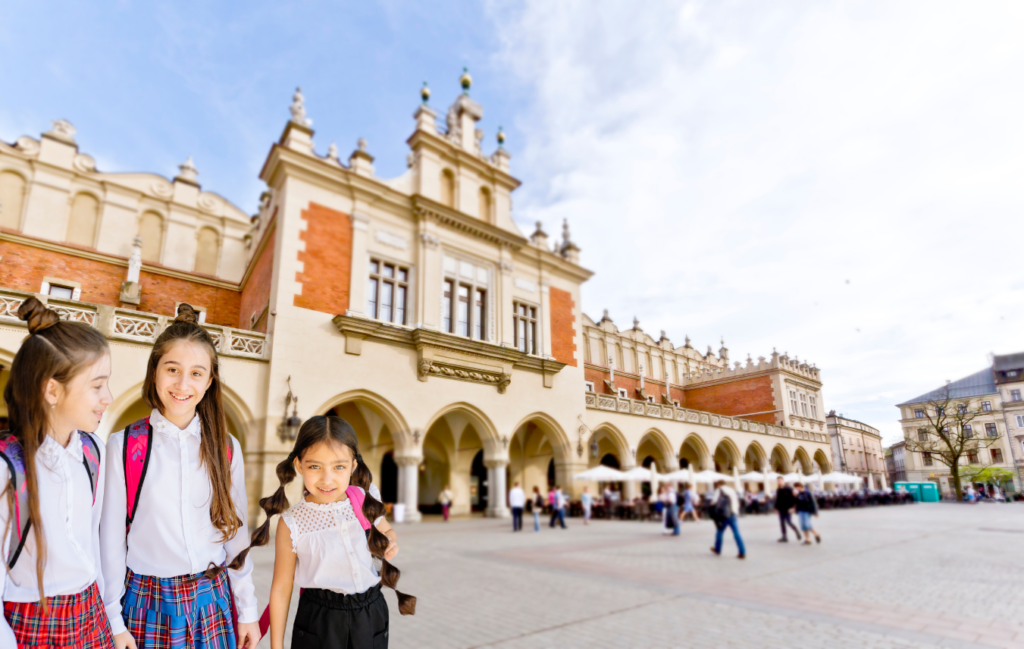
School trip to Krakow: how to match attractions to your class
How to plan a school trip to Krakow: Wawel sessions, the Dragon’s Den, the Botanic Garden, an escape room and city games matched to the age of the class, with paperwork, a sample day and costs.
Redakcja KrakowSecrets
/
Publikacja: February 22, 2023
/
Aktualizacja: October 1, 2026
In this guide
A good school trip to Krakow combines one historical highlight, one bit of moving about in the fresh air and one hands-on task for the students. Wawel and the Main Market Square come up again and again in school trip packages. This guide helps you build the rest of the day around them, based on the age of the class, the number of supervisors and the purpose of the trip. You’ll find attractions checked on their official websites, an escape room and a city game as one of the modules, the paperwork, and a sample plan for the day.
Solving puzzles or visiting a museum doesn’t make a trip programme on its own. You also need a plan for splitting the class into groups, a schedule and clarity about who is responsible for the students at each stage of the day.
Paperwork before you go
In Poland, trips for public schools are organised under the Minister of National Education’s regulation of 25 May 2018 on sightseeing and tourism. The head teacher approves the trip form (karta wycieczki) and appoints a trip leader and supervisors. Parents of students under 18 give their consent in writing, and a list of participants with their parents’ phone numbers is attached to the trip form.
The regulation doesn’t set a single number of supervisors per group. You agree it with the head teacher, taking into account the students’ age, the programme and whether the class will be split into teams. If several teams play at the same time, each one should have a supervisor assigned to it.
Wawel: museum workshops for schools
Wawel Royal Castle runs sessions for school groups divided by stage of education, from nursery to secondary school. For example, the sessions in the programme for grades 4 to 8 last 60 minutes and take place in selected rooms of the Royal Private Apartments and the Royal State Rooms. You can check the topics, booking rules and dates on the Castle’s page for schools and teachers (in Polish).
It’s a good slot for the morning, while the students are still focused. After the session you can head to the Dragon’s Den or walk down to the riverside boulevards.
The Dragon’s Den and the dragon below Wawel
The Dragon’s Den is a short route that’s easy to tie in with the legend of the dragon. The entrance is by the Thieves’ Tower on Wawel Hill, 135 steps lead down to the cave, and it’s a one-way route, with the exit on the boulevard below the dragon statue. The route isn’t accessible to wheelchair users, and the cave is open seasonally.
If there’s a student in the class who can’t manage the stairs, a supervisor can wait with them at the dragon statue on Bulwar Czerwieński. The statue is free to visit and there are no architectural barriers. The rest of the class will come out of the cave right at that spot.
The Botanic Garden for a science lesson
The Jagiellonian University Botanic Garden at ul. Kopernika 27 is a calmer stop close to the centre. There’s an admission fee, with reduced-price tickets. Opening hours change from month to month and are shortest from November to February. The greenhouses and the garden museum are closed on Mondays, so don’t plan them for that day.
An escape room as a hands-on module
Gamescape at ul. Tadeusza Kościuszki 74 has an offer for schools. According to the operator’s website, it welcomes children aged 8 and over, takes groups of 15 to 52 people, and a game lasts between one hour and an hour and a half. With that many students, the class plays in several rooms at the same time, and if needed the operator makes the puzzles easier and adjusts the difficulty to the students’ age. Teachers and supervisors play for free. The operator also mentions possible funding for students who can’t afford to take part. All it takes is an email describing the situation.
The operator names two rooms for school classes. Enchanted Amulets is a world of magic for students who love fantasy. In Chimera Protocol, paintings by Krakow’s master painters are part of the puzzles, which makes it easy to link with an art or history lesson. The crime-themed Anatomy of Crime 2 is for players aged 16 and over only.
With a bigger class, ask what the groups that start later or finish earlier will be doing. Supervisors should know which students are in which room. The Game Master runs the game, but doesn’t replace school supervision.
A city game: a lesson out and about
In Gamescape’s city games, each team gets an iPad with a GPS map and a route full of puzzles, some of them in augmented reality. The schools offer mentions two hours of outdoor play. The individual games differ in age range, duration and route, though, so don’t assume one game’s details apply to another:

- Magic Portal: a fantasy game for children aged 7 to 12, teams of 1 to 6, 120 minutes, difficulty 4/10, a route of up to 3.5 km towards Wawel.
- Eight Portals: fantasy, teams of 1 to 4, 140 minutes, difficulty 6/10, a route of up to 3.5 km around Aleja Waszyngtona and Emaus.
- Operation Mindfall: a spy mission, teams of 1 to 4, 140 minutes, difficulty 7/10, a route of up to 3.5 km towards Wawel.
All three start and finish at ul. Kościuszki 74. Before you book, check how many teams you’ll need for your number of students, how you can reach the staff during the game, and whether a supervisor goes with each team.
Another option is Krakow Legends, a smartphone app game around the city centre based on Krakow’s legends. There’s no time limit or fixed start time, you can take breaks, and each team plays on one phone. The website describes the game as one for families, couples and small groups, and there’s no separate schools offer. For a whole class, contact the organiser to find out how many access codes you’ll need.
How to match attractions to the age of the class
- Grades 1 to 3: the Dragon’s Den paired with the dragon legend, a city game for children (Magic Portal, from age 7) or an escape room with easier puzzles from age 8. Shorter walks and more breaks.
- Grades 4 to 8: a session at Wawel from the programme for these grades, then an escape room or a city game with a route towards Wawel.
- Secondary schools: Wawel sessions for older students and a more challenging outdoor game. The crime-themed room is only an option if every participant is at least 16.
A sample plan for the day
- Morning: a session at Wawel (about an hour) and a walk around the hill. If the class arrives after a long journey, start with a calmer stop and save the more intense module for later.
- The Dragon’s Den, if it’s open, with the exit below the dragon statue on the boulevard.
- Lunch and a longer break.
- Afternoon: an escape room (one hour to an hour and a half) or a city game (about two hours). Allow time to get from the centre to ul. Kościuszki 74 and for the briefing before the start.
- Whole-class meeting point, register check and the journey home.
This plan is a starting point, not a ready-made schedule. Check walking times, opening hours and availability for your specific date.
Costs without surprises
Prices change, so we don’t quote any figures. When comparing offers, check whether the price is per student or per team, whether supervisors pay, whether there are reduced-price tickets and whether the game equipment is included. Add transport and a meal to the cost of the attractions. Ask each place for a quote for the exact number of students and supervisors. With an escape room, compare the cost of the whole organisation rather than the price for one team: the class plays in several teams, and those waiting for their turn need space, supervision and access to toilets.
Safety and supervision during the day
Outdoors, take into account the weather, the shorter days in autumn and winter, and the needs of students with limited mobility. In its escape rooms, the operator mentions unlocked doors, video monitoring and safety buttons, but some rooms have narrow passages, so ask which rooms your class will get. At the Dragon’s Den, remember the stairs and the one-way route.
A little preparation helps you make the most of the trip
You can give the class one goal, for example sharing discoveries with everyone on the team. After the game, ask when that worked and when information stayed with just one person. That kind of conversation is more concrete than a promise that every puzzle will boost creativity.
A trip is ready when all its parts fit the class, not just when you’ve picked an interesting title.
Author of this post

Redakcja KrakowSecrets
Zespół redakcyjny KrakowSecrets. Piszemy o krakowskich miejscach, trasach i wydarzeniach, a praktyczne szczegóły – godziny, ceny, dojazd – sprawdzamy przed publikacją.
More from this category
Latest posts
Recently added
Editor’s note
One good tip every Wednesday
No daily noise or random list of events.
gramiejskakrakow.pl
Turn a walk into a city mission
If you’re going as a group, choose the version with puzzles and a shared finale.
More from the blog