Escape room or escape box? Two ways to play together
What an escape box is and how it differs from an escape room: location, number of players, time and who runs the game, plus when a box is the better choice for a company event in Krakow.
Redakcja KrakowSecrets
/
Publikacja: July 2, 2025
/
Aktualizacja: October 1, 2026
In this guide
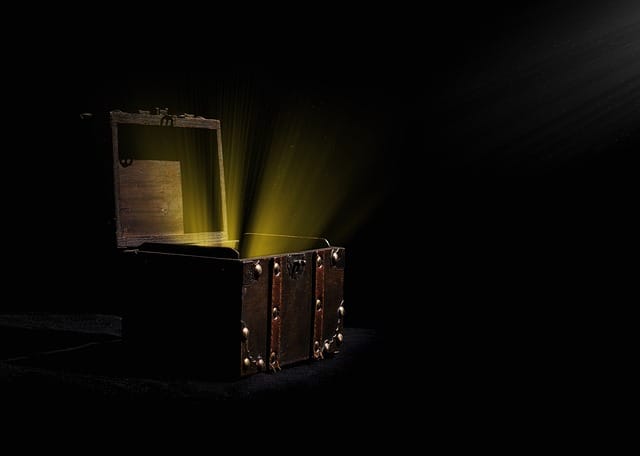
An escape box is a portable game in the style of an escape room. Instead of walking into a fitted-out room, the team gets a locked box or case full of padlocks, ciphers, documents and objects, and solves the puzzles at a table wherever you choose: in the office, a hotel conference room, at home or outdoors. An escape room works the other way round: the players travel to a prepared space, and the space itself becomes part of the story.
Both are built on the same things: searching for clues together, cracking codes and racing the clock. What sets them apart is the location, the scale of the set and the logistics. For a company event, start by asking one question: can the whole group get to one place, or should the game come to them?
How is a box different from a room?
- Location: a room stays put, a box comes to the players. There’s no need to get the whole group across town.
- Set: in a room, the surroundings are part of the adventure. With a box, the story is usually in the background and the focus is on a single kit.
- Number of players: a room has a player limit for each scenario. A bigger group is split into teams, and each team gets its own box.
- Time: a single box can take anything from ten or twenty minutes to a full game, while a room has a set time on its scenario page.
- Running the game: in a room, the operator’s staff follow the game. With a box at an event, the Game Master arrives with the kits. Ready-made kits for home often have no Game Master at all.
A box isn’t another word for every mobile game, either. A portable set can fill a whole room, while a small kit takes up only part of a table. When you book, ask which of these the offer includes.
The room: the story fills the space
In a fixed escape room, players look at different parts of the space, share what they’ve found and gradually work out its rules. The story might lead to completing a mission, not necessarily to literally opening a door.
The advantage is a prepared space and a game run according to the operator’s rules. The limits are the date, getting there and the number of people the scenario is designed for. For a big team, that usually means several rooms playing at the same time, or spreading the games out over time.
The box: focus on a single kit
The group works around the kit, so moving around the space matters less and passing things on so everyone can take a look matters more. With a bigger team it’s easy to end up queuing for one padlock, so it’s worth matching the number of people at a box to the number of tasks that can be done in parallel.
Not every box lets you play at your own pace and wherever you like. Check the time limit, what you’ll need in terms of a table, lighting and devices, and whether a Game Master will be there. Playing outdoors also means a risk of small parts getting wet or lost.
What does a box look like at a company event?
In Krakow, the EscapeCity mobile escape room is built around exactly that: black boxes full of puzzles, padlocks and codes. The operator says the game works for groups from 10 to over 100 people, either in a short format of 10 to 30 minutes (for example during a conference break) or as a full scenario of 60 to 90 minutes. In competition mode several teams play under the same conditions, and Game Masters are on site for the whole event. The standard languages are Polish and English.

An example from an EscapeCity case study: 25 people at a client’s Krakow office were split into 5 teams, each got a different box, and the whole activity took 2 hours. It was 7 days from the enquiry to the event. That’s one described case, not a standard lead time, so always confirm the date with the organiser.
Local history in a small format
The Krakow Riddle Chest appeared at the Christmas market on the Main Market Square on 11 and 18 December 2024. According to EscapeCity’s write-up, the puzzles drew on Krakow traditions, one game took about 20 minutes, teams had 2 to 4 people, and around 70 people played, including families with children. This dated example shows how a box can be built into a bigger event. It doesn’t mean the same kit is available on any date you like.
What matters most is that the local theme shapes the tasks instead of just appearing on the label. Ideally, by the end the players can say why the object they found mattered to the story.
Which one should you choose for an event?
- Choose a box when: the group is big, the event is in an office, a hotel or at a conference, you only have a short slot in the programme for the game, or you want several teams to compete under the same conditions.
- Choose a room when: you care about the set and the atmosphere, the group fits within the scenario’s limit (or across several rooms at once) and everyone can get to one address.
- Ask the organiser about: the number of kits or rooms for your group, how long one round takes, how much space and how many tables you’ll need, whether a Game Master will be there and the language of the game.
Doing well in one format isn’t an entrance exam for the other. You can enjoy both, and each time pick the kind of fun that suits the occasion.
Author of this post

Redakcja KrakowSecrets
Zespół redakcyjny KrakowSecrets. Piszemy o krakowskich miejscach, trasach i wydarzeniach, a praktyczne szczegóły – godziny, ceny, dojazd – sprawdzamy przed publikacją.
More from this category
Latest posts
Recently added
Editor’s note
One good tip every Wednesday
No daily noise or random list of events.
gramiejskakrakow.pl
Turn a walk into a city mission
If you’re going as a group, choose the version with puzzles and a shared finale.
More from the blog