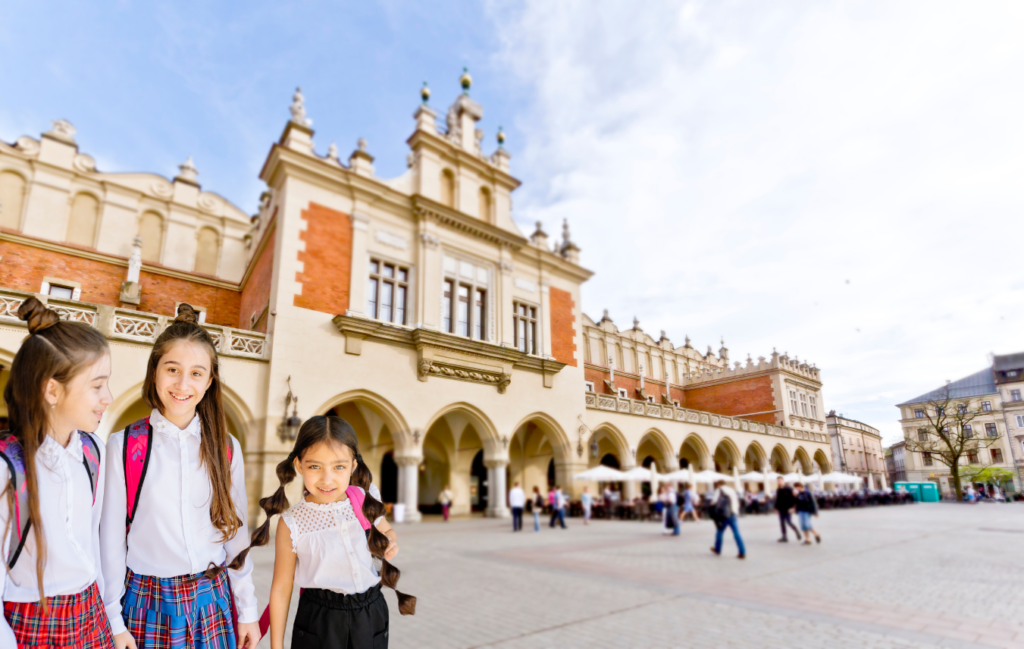
City games: puzzles and finding your way in the open air
What a city game is and how it works step by step, the main kinds you’ll find in Krakow, how long games and routes take, and when a city game is or isn’t a good fit for your group.
Redakcja KrakowSecrets
/
Publikacja: March 24, 2024
/
Aktualizacja: October 1, 2026
In this guide
A city game is a game where the board is a real city. Your team follows a set route, completes tasks and solves puzzles at each point, and looks for the answers in the surroundings: on plaques, facades, monuments or in the layout of the streets. A story or a goal ties it all together, for example finding treasure, solving a crime or uncovering a legend. The games described here take from 90 to 140 minutes, and their routes are about 2 to 3.5 km long.
It’s something between a guided walk, a scouting treasure hunt and an escape room taken out onto the streets. Nobody leads you by the hand from one landmark to the next. Your team decides where to go, what counts as a clue and when a task is solved.
The format has its roots. According to the Pilecki Institute’s guide “Gra miejska. Krok po kroku” (City Game: Step by Step), a city game combines elements of scouting field games, orienteering events, role-playing games, flash mobs and happenings. Its history probably goes back to the interwar years, when people played Ringolevio, a version of hide-and-seek, on the streets of New York. In Poland its roots are traced to the scouting movement, and in the 1990s interest grew noticeably, partly thanks to RMF FM radio’s “Inwazja Mocy” and later the “Urban Playground” series.
How does a game work, step by step?
Most games follow a similar pattern, whatever the theme:
- Start: your team gets an introduction to the story and the rules. In staffed games you usually get equipment too; in app games your own phone is enough.
- Getting to the next point: a map or a clue leads you to the next spot. In GPS games the device shows your position and your destination.
- The task on the spot: you have to notice, count, compare or read something, then link it to information from the story.
- Answer and move on: the right answer unlocks the next stage. If you get stuck, you can usually use a hint.
- Finish: the end of the story, your team’s score and, in games with equipment, handing it back.
Here’s what a single task might look like: you have to find a plaque on the corner of a building and compare its date with a message you’ve received. First you have to get there, then spot the right detail, and finally draw a conclusion. It’s a made-up example, not a solution from an existing game.
What kinds of city games will you find in Krakow?
The main differences between games are who runs them and whether you need to book a slot. The guide mentioned above divides them into staffed games, which need organisers and take place at a set time, and self-guided games, which you play on your own whenever you like:
- An iPad game with augmented reality, booked in advance: this is how EscapeCity games, run by Gamescape, work. Your team gets an iPad with a GPS map, and digital characters and objects appear on screen against the real streets. You call up hints in the app. According to the EscapeCity city games page, in light rain the game goes ahead, and in a gale, a downpour or a storm another date is arranged.
- An app game on your own phone, no booking needed: for example Krakow Legends. You need an Android or iOS phone with GPS turned on. There’s no start time and no time limit, you can take breaks and come back to the game later.
- A game for a large group: companies, schools and institutions order a scenario for many teams at once. EscapeCity then splits participants into teams of four to six, and the scoring shows the team rankings.
- An outdoor game from a city institution: Krakow’s Municipal Greenspace Authority has created an outdoor game, “Planty wczoraj i dziś: Ogród Wawel” (The Planty Yesterday and Today: Wawel Garden), in its “Kraków w zieleni” app, based on the history and nature of this part of the Planty (in Polish). It’s an example of a game where getting to know the park matters more than an adventure story.
Example routes and what they involve
To see how different games can be, just compare a few scenarios from the operator’s game pages (checked in September 2026):
- Treasure Hunters: a family pirate adventure, 1 to 6 players, 90 minutes, about 2 km along a path by the Rudawa river.
- Magic Portal: fantasy for children, 1 to 6 players, 120 minutes, difficulty 4/10.
- The Last Crime: a story-driven crime game in Zwierzyniec, 1 to 4 players, 140 minutes, a route of about 3.5 km.
- Eight Portals: fantasy with archive photos of Krakow, 1 to 4 players, 140 minutes.
- Operation Mindfall: a spy mission, 1 to 4 players, 140 minutes, difficulty 7/10.
So time and distance depend on the scenario. Don’t carry one game’s details over to another, and when you book, confirm the total time including the introduction.
What do players get out of a city game?
A game gives your walk a purpose. Instead of following a guide, your team looks for details that are easy to miss day to day. For visitors it’s a way to get to know the city on the move; for locals it’s an excuse to take a closer look at familiar streets. That’s also how you spot a good city game: the task uses something specific to the place, such as an inscription, the street layout or the history of a building. If the answer would look the same in any city, the city is just a backdrop.
The second benefit is working together. One person reads the task, another checks the map, someone else compares the clue with the surroundings. We won’t promise that one game will permanently improve your sense of direction or logical thinking. What we can honestly say is that for two hours your team practises exactly those things: observing, connecting information and making decisions together.
Who is it for, and when is something else a better choice?
A city game is a good fit if you like moving about, enjoy puzzles and want to see the city along the way. It works for families, friends, team outings and first-time visitors to Krakow.
Think twice when:
- someone finds longer walks difficult: a route of up to 3.5 km with stops usually means two hours on your feet. A shorter game, like Treasure Hunters, or an app game with breaks may be a better choice;
- you’re playing with small children: choose a scenario made for kids, and remember that near traffic an adult’s attention has to stay on the road, not on the puzzle;
- the forecast is really bad: a booked game can be moved, and an app game you can simply start on another day.
Logic starts with gathering information
In a group, it’s worth splitting up reading the instructions and watching your surroundings. Once you find a clue, say out loud what follows from it. If an answer is wrong, go back to your assumption instead of typing in more random guesses.
It helps to separate what you know from what you suspect. “There are three dates on the plaque” is an observation. “We need to use the oldest one” is a hypothesis that needs confirming in the task.
It’s also worth telling fact, legend and fictional mission apart. The date on a plaque is a fact, the tale of the dragon is a legend, and saving the world is the game’s story. In a historical game sources matter; in a fantasy game it’s the consistency of the story. Putting a landmark’s name in a story doesn’t make the game a history lesson.
Get ready for walking and stops
Before you start, check whether the organiser provides the equipment, where the game starts and ends, and how long it takes. If you’re playing on your own phone, make sure the battery is charged and the app is downloaded.
Comfortable shoes and clothes for the weather come in handy even in the city centre. Puzzles mean stops, so set a pace that works for the whole team. The city is still an everyday space for other people, even when your story is telling you to save the world.
After the finish, go back to one discovery and ask where the information came from. Everyone remembers something different: a building, a line of dialogue or the moment the clues suddenly clicked.
Author of this post

Redakcja KrakowSecrets
Zespół redakcyjny KrakowSecrets. Piszemy o krakowskich miejscach, trasach i wydarzeniach, a praktyczne szczegóły – godziny, ceny, dojazd – sprawdzamy przed publikacją.
More from this category
Latest posts
Recently added
Editor’s note
One good tip every Wednesday
No daily noise or random list of events.
gramiejskakrakow.pl
Turn a walk into a city mission
If you’re going as a group, choose the version with puzzles and a shared finale.
More from the blog