A city game as a boost for learning English
How a city game in English can support language learning on a school trip to Krakow: a sample route, age and level, warm-up exercises and what to ask the organiser.
Redakcja KrakowSecrets
/
Publikacja: September 13, 2024
/
Aktualizacja: October 1, 2026
In this guide
Yes, a city game in English can be a great part of a school trip to Krakow, as long as you match it to your class’s level. Two Krakow city game operators, EscapeCity and Gamescape, say they can run games for schools in English. Students then walk a route through the centre in teams, read the clues on a tablet and work out the answers, and English becomes the tool that moves the story forward.
Not every game in a foreign language is a lesson, though. The English version is often designed for tourists who use the language with ease, not for beginners. The operators don’t state the language level of their materials, so you need to check it yourself before booking.
What does a game like this look like in Krakow?
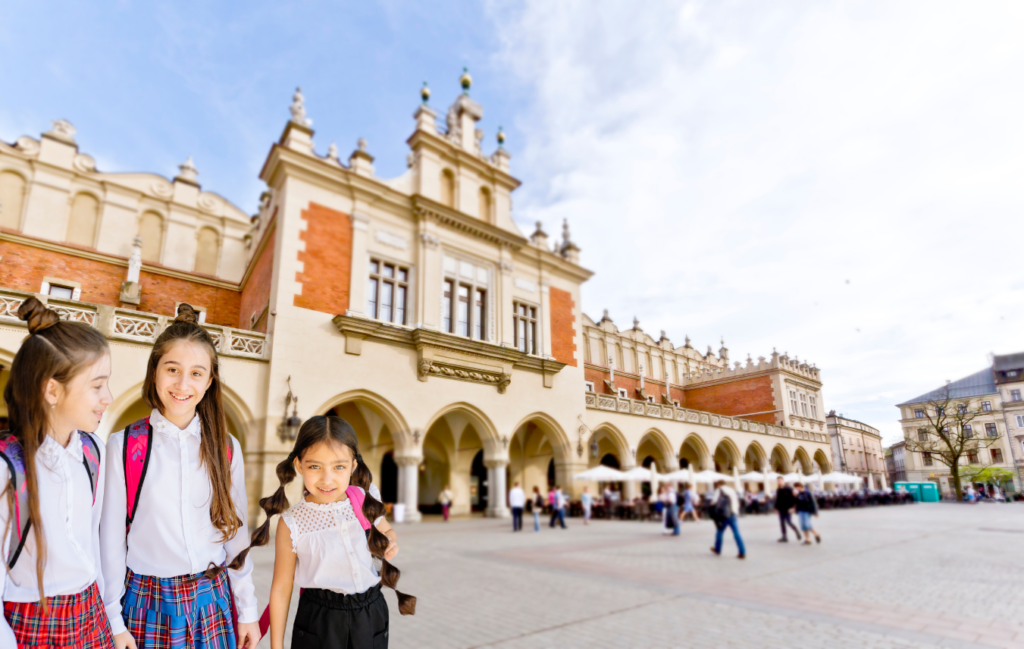
A good example of a route is Kraków Legends, EscapeCity’s augmented reality game. It follows the Royal Route, the historic trail from Matejko Square through St Florian’s Gate and the Old Town towards Wawel. The route is about 3 km long, the full version takes up to 2.5 hours, and the shorter one takes up to 2 hours and starts on Plac Mariacki. Game Masters split the players into teams, each team gets an iPad and a set of props, and everyone finishes at a shared finish line on the Vistula Embankments.
The operator promises puzzles linked to places on the route, for example about St Florian’s Gate, a treasure in Krzysztofory or a book in the Jagiellonian Library with the devil’s paw print pressed into it. For a language teacher that’s valuable information: you know the topics of the tasks before the trip, so you can prepare the vocabulary in advance.
EscapeCity’s school games last 2 or 2.5 hours, depending on the route, and can take place in the Old Town, Kazimierz or Nowa Huta. In its offer for schools, Gamescape mentions two hours of outdoor play, an iPad with the route for each team and the option of running the game in English on request.
Students’ age and language level
The operators don’t match their games to language levels or school years. They do, however, give guidance on age:
- Gamescape’s Magic Portal is a city game for children aged 7 to 12, lasting 120 minutes, which can be played in English.
- Eight Portals lasts 140 minutes and also has an English version. The operator rates its difficulty at 6/10.
- EscapeCity says its games for schools are adapted to the participants’ age, and it chooses the scenario once it has the number of students, their age and the date of the trip.
Based on this, you can adopt a working rule. Younger primary school classes will do better with a children’s game with short instructions, while the full game in English makes more sense once students can read simple narrative texts on their own. That’s our suggested rule of thumb, not the operators’ recommendation. Before you book, ask for a sample task in English and check whether your class understands it without an interpreter.
The language needed to complete a task
The instructions may include words for direction, position and order. The story materials add vocabulary linked to the theme: a legend, a journey or an investigation. Knowing individual words is only part of the job, because students also need to understand what the task expects of them.
Here’s a simple rule you can use: after reading a message, one person explains its meaning to the team in their own words. The others check whether anything was missed. This helps avoid a situation where everyone moves on, even though only one person understands the goal.
Language tasks to try before you set off
These exercises are our own ideas for preparation, not tasks from a commercial game. They’re linked to places along the Royal Route:
- Position: on a photo of St Florian’s Gate, point to something above the passage, and then describe it in English (above, below, between, next to).
- Directions: on a map of the Royal Route, students work in pairs and guide each other verbally from Matejko Square to the Main Market Square (turn left, go straight, opposite).
- Legend vocabulary: before the trip, the class builds a mini glossary for Krakow’s legends, for example dragon, cave, treasure, devil, spell.
- Understanding instructions: the teacher writes a short instruction in the style of the game, and students swap the roles of reader and doer. If the first version is too hard, you can add a mini glossary of position words.
Preparing like this shows you whether the difficulty lies in the language of the instructions or in the observation itself.
What to agree with the organiser
When you plan the game, tell the organiser that practising the language is one of your goals. It’s worth asking four things:
- whether the whole game, including the hints and the briefing, is in English,
- whether the Game Master will help students understand an instruction without giving away the solution,
- how long the texts on the tablet are, and whether you can get an example before the trip,
- how many people are in each team, because that decides whether every student will get to read and speak.
In each team, it’s a good idea to rotate who reads and who speaks. If one student translates everything into their own language, the rest can finish the route with little contact with English.
When you don’t need an organiser
A smaller group, for example a few students with a teacher on a free afternoon, can use a game in an app. Krakow Legends is the English version of the website for the Legendy Krakowskie game (not to be confused with EscapeCity’s game above): it runs on your own phone with GPS, with no booking, no time limit and the option to take breaks. One access covers the game on one phone, so with several teams each one needs its own. Before the trip, check in the app whether the tasks are displayed in English.
What to do after the game
Ask the players to pick three useful phrases from the materials and make up their own sentences with them. They can also describe in English how their team handled one stage, without giving away the solution.
A recap like this helps students come back to the content instead of leaving it only in the excitement of the walk. A game can bring variety to learning, but the lasting effect also depends on preparation, level and follow-up work. The best part is that the language serves a real purpose here: communicating within the team and understanding the task.
Author of this post

Redakcja KrakowSecrets
Zespół redakcyjny KrakowSecrets. Piszemy o krakowskich miejscach, trasach i wydarzeniach, a praktyczne szczegóły – godziny, ceny, dojazd – sprawdzamy przed publikacją.
More from this category
Latest posts
Recently added
Editor’s note
One good tip every Wednesday
No daily noise or random list of events.
gramiejskakrakow.pl
Turn a walk into a city mission
If you’re going as a group, choose the version with puzzles and a shared finale.
More from the blog